Showing posts with label God's Name. Show all posts

8/6/14

Calling on the Name of the Lord in NT - 4

Subject:  "Yahweh" or "Lord"? 


When we read the NT, we notice  a discrepancy between the NT and OT: 

  • "Call on the Name of Yahweh" in OT 
Joel 2:32 "And it shall come to pass, that whosoever shall call on the Name of  Yahweh shall be delivered …"

  • "Call on the Name of the Lord" in NT
"And it shall come to pass, that whosoever shall call on the Name of the Lord shall be saved."  Acts 2:21
“Everyone who calls on the Name of the Lord will be saved.” Romans 10:13

Acts 2:21 & Romans 10:13 are quoting from Joel 2:32:

  • Why doesn't the NT say to "call on the Name of Yahweh?"
  • Why does NT replace "Yahweh" with "Lord"?

----------------------

We need to realize that the OT is written in Hebrew while the NT is written in Greek. 

  • In the  original Hebrew text, "Yahweh" is there. 
  • But in the NT,  the word "Yahweh" is taken out.  "Yahweh"  is replaced with "Lord".   


In the NT times, very few people used the Hebrew Old Testament as Greek became the common language. Around 250 BC, the Hebrew Old Testament was translated into Greek by Jewish scholars.  This translation is called the Septuagint translation known as the LXX (70).  The LXX was used widely among the apostles in the Gentile Grecian world.  In the process of translations, the Jews were afraid to say God's Name, so whenever they saw "Yahweh", they replaced God's Name with "Adonai".   In Greek, "Adonai" was translated as "kurios".   "kurios" is "Lord" in English. 

The Greek translation in the LXX for Joel 2:32 is, "hos an epikalesastai to onoma kuriou" which when translated to English is "whosoever shall call upon the name of the Lord."


So whenever we see OT quotations in the NT, they are usually quoting from the LXX rather than from the Hebrew text.

This is why in Acts 2:21 and Rom 10:13, it reads "Whosoever shall call on the name of the Lord shall be saved. 

  • These are quotes taken from the LXX.  
  • You see 'Lord' there because it is a translation from the Greek word 'kurios'.

Peter & Paul are quoting from the LXX version of Joel 2:32.

---------------------------------

But when we look at the original Hebrew text of Joel 2:32, this is what we read:

"And it shall come to pass, that whosoever shall call on the Name of  Yahweh shall be delivered …"  

It says specifically to call on the Name of Yahweh.


This is an unfortunate thing that happened in the process of translation.  "Yahweh" is replaced by the word "kurios" in Greek.  "Yahweh" is replaced by a title "Lord". 


Let not the unfortunate "weakness" of translation hinder us from calling on the Name of Yahweh!


"Yahweh" is not written in most of our modern day Bible translations. "Yahweh" is replaced by the word "LORD".  This is one of the reason why God's Name is hardly mentioned in the churches.  

This is so sad because "Yahweh" appears nearly 7000X, the most frequent noun in the Bible, the most important Name in the Bible, yet the distinctive personal Name of God is totally wiped out in our Bibles translations. The most important revelation of "I am Yahweh" from God is gone.

God's Name had turned silent down through the centuries.  


Today, let's arise and focus on calling on the Name of Yahweh that the outpouring of the Spirit will fill His people in these end times for the final deliverance.


:)

Calling on the Name of the Lord in NT - 3

Subject:  Calling & Final Salvation 


The apostle Peter also exhorts the early churches to call on the Name of the Lord.


Acts 2:21And it shall come to pass, that whosoever shall call on the Name of the Lord shall be saved.

"Call on the Name of the Lord" is linked with our final salvation.

The Bible tells us that there is a progression in our salvation - past, present and future.   Our final salvation is in the future.  

Our final salvation is summed up in these words: 
Calling on the Name of the Lord.  

Who is going to be saved?  
Those who call on the name of the Lord.  

Wow, this matter of calling on the Lord is so important that it concerns our eternal salvation - whether we will finally be saved in the end.

Can you see how important this matter of calling on the Lord is?  Our eternal salvation depends on our calling on the Name of the Lord.

Do you want to learn to call on the Name of the Lord?


Acts 2:21 is part of the message of  Peter's Pentecostal sermon to the early church.  We are so blessed to have this first sermon recorded for us in detail.  Peter mentions about "calling on the Name of the Lord" as Peter is actually quoting a prophecy from the prophet Joel regarding the last days:  

Acts 2:21 is quoting specifically from Joel 2:32. 

 Joel 2:32  "And it shall come to pass, that whosoever shall call on the Name of  Yahweh shall be delivered: for in mount Zion and in Jerusalem shall be deliverance, as Yahweh has said, and in the remnant whom Yahweh shall call." 


Exegetically, we can see that "Call on the Name of the Lord" means specifically "Call on the Name of Yahweh" here.  (Tomorrow, I will go into the detail of the technical aspect of this part of the exegesis.)


Joel 2:32 is a prophecy to be fulfilled in the last days which had already begun at Pentecost.  We are now living in the end times where we, too, experience the outpouring of the Spirit of God on all people as we wait for the day of Yahweh, and both Joel & Peter exhort everyone to call on the Name of Yahweh for our final salvation. 

Whether we will finally have salvation depends on our calling on Yahweh.

Thus, it is urgent for us to learn together to call on Yahweh in these last days.  This calling on the Name of Yahweh is not a mere verbal calling mouthing God's Name.  It is not a magic formula.  It is not even a verbal recognition of God's Name.  It is focusing on Yahweh, to call and live in the presence of Yahweh, delighting to do His will until we finally see Him face to face. 

To understand what this means will take many more hundreds of articles to share, which I will try to attempt in the coming topics.

Let's make a start to call on Yahweh in our prayers.

:)


8/1/14

Calling on the Name of the Lord in NT - 2

Subject:  A Continual Calling by Faith


At the end of Paul's life,  he exhorted young Timothy with these words,  "Flee also youthful lusts: but follow righteousness, faith, charity, peace, with them that call on the Lord out of a pure heart."  2 Timothy 2:22

Here we have a glimpse of what the community of believers are like in the early church.  How are the early church Christians identified here?  Those who 'call on the Lord'. 

The verb 'Call' is in the simple present tense meaning that this is an action that is repeated on a regular basis.  This is not a one time action at baptism.  It is a continual calling in the life of a believer.  This factual statement tells us that the early believers are in the habit of calling on the Lord all the time.  And out of a pure heart too! It's a continual expression of faith to God!

Calling on the Lord has to do with prayer.  Calling on the Lord is the mark of the early Christians. 

If you are a Christian, do you pray and call on the Lord?  If you don't call on the Lord, you are not even a Christian in Biblical terms.

I have a word of encouragement to our young people:  It is truly possible for us to live a life of purity.  We cannot live in purity in our own strength.  Many young people have difficulty controlling their youthful lusts.  This can become a lonely defeating battle.

So Paul gives a very concrete spiritual direction to help young Timothy to fight against sinful lust.  How?  To be together with Christians who call on the Lord to pursue after purity, righteousness, faith, love and peace.

What kind of Christians call on the Lord?  Surely it is not just the 'mere act of calling', as the emphasis here is on the "kind" of life they live.  These Christians who earnestly call on the Lord are people actively pursuing holiness, living a life of purity before God in prayer. They spend time in prayer calling on the Lord.

Do you take time to pray? Are you willing to spend time to pray and call on the Lord? We have prayer partners and we pray together in our church, as we are a community of  brothers and sisters keepers to call on the Lord together to pursue God with a pure heart.

Indeed, this is a beautiful picture of a church! 
"Those who call on the Lord out of a pure heart."


This 'calling on the Lord" is more than an individual matter but a community praying together earnestly focusing on the Lord.

A church that calls on the Lord is a church of faith!

When there is no earnest desire calling on the Lord in our churches, it only shows that there is very little faith.  When there is no concern to call on the Lord, it only shows that we have no faith in our churches.


:)

6/12/14

Calling On Yahweh's EVERLASTING Name - 2

Subject:  Your Name, O YAHWEH is EVERLASTING


Calling on God's Name is something that the Psalmists naturally do in their prayers.  You see this all over the place in the book of Psalms.

But sadly today, when we share with Christians that they need to call on God's Name in prayer, they look very puzzled and their minds are full of questions. 

Some of the questions I get asked are:

1.  How do I call on God's Name?
2.  What exactly is God's Name?
3.  Which name of God do I call on?
4.  How do I pronounce God's Name correctly?
etc.

Their questions are legitimate because down through the centuries, Christians have stopped calling on God's Name.  We don't know where to begin.  All of a sudden "Calling on God's Name" becomes a 'study' that we need to look into, just like what we are doing in this Blog page.

This Blog page is a good start to bring us together to the importance of calling on God's Name.  


In this new topic #6, I want to impress on your mind that first and foremost, you need FAITH to call on God's Name.  It is not a method that you need to learn.  It is not a theory that you need to memorize.  

You must have FAITH when you call on God's Name, because God's Name,  Yahweh is an Everlasting Name.


Psalm 135:13   Your Name, O Yahweh, is EVERLASTING.

1.  Psalmist specifically calls on God's Name in prayer: "O Yahweh".
2.  Psalmist recognizes God's Name is everlasting.

The Hebrew word "everlasting" is "olam". 
Olam means to last forever.  

Our Names are not eternal. We live in this physical world where everything is temporal.  Temporal things are things that belong to this age.  What we can see with our eyes do not require faith.

Nothing on this earth lasts forever.  Everything has an expiry date. 


Our Everlasting God has an everlasting Name that lasts forever. 

God's Name, Yahweh, lives forever.
God's Name, Yahweh, never grows old.
God's Name, Yahweh, remains true always.
God's Name, Yahweh, will never change.
God's Name, Yahweh, has no expiry date.

Can you see that God has given us something of great eternal value?  
Do we have faith to call on God's Name that carries everlasting significance?

Now we begin to understand why we do not call on God's Name.  Sadly, most Christians pursue things of this temporal world, what they can see with their eyes and what they can grasp with their hands.  As a result, all their times are spent on things that soon expire and disappear in front of their eyes.

Who wants to spend time on prayer?  Do you spend time with God?

To call on Yahweh is to spend time with the Everlasting God.  You cannot see God with your eyes.  You need FAITH.  We walk by FAITH, not by sight. This is the most important principle in prayer when we call "O Yahweh, your Name is Everlasting." 

Our everlasting God has an everlasting Name that never expires.
God’s Name, Yahweh, also lives forever.
God's Name, Yahweh, will never die.


Let's hold on to God's Name Yahweh and spend time today to call upon Yahweh.  

  • It maybe just 5 minutes.  Try it.  It is a good start already.  
  • Whisper from your heart, "Your Name, O Yahweh, is everlasting."

Tomorrow we will learn from a servant of God who calls on Yahweh's Everlasting Name.  Can you take a guess who he might be? It is in Genesis.

 :)


6/5/14

Calling On Yahweh's EVERLASTING Name - 1

Subject:  6 Bible Statistics Graph - Importance of Yahweh's EVERLASTING Name

In this coming week, we are going to start a new topic on Yahweh's Everlasting Name.  

  • In Topic 4, we looked at "This is My Name FOREVER"
  • In Topic 5, we looked at "Blessed be the Name of God FOREVER"
  • For Topic 6, we will look at "Calling on Yahweh's EVERLASTING Name"
Hopefully in these 3 sequential series of Topics, you can see the importance of the 'eternal' nature of God's Name.  

Yahweh's Name is not like any name.  
Yahweh's Name is an Everlasting Name.  

When we call on God, we are calling on God's Everlasting Name.  

In the following days, we will see examples of prophets and men of God consciously calling on God's Name, paying special attention to the 'everlasting' nature of Yahweh.


For today, I will post 6 Bible statistics Graphs for you to have a general overview again on the significance of God's Name - Yahweh.


The following 6 sets of words are very important to our present study. From now on, whenever you come across these words in your Bible, highlight them.  You will find that you will see these words appearing on every page in your Bible.


After serving Yahweh God for 25 years, I have now come to realize the significance of the Name of God, Yahweh in the Bible.


Just looking at the following 6 statistics graph will give you a lot of insights about God's mind as He reveals His Name to you in the different books of the Old Testament.


1.  Yahweh - the most frequent noun in the Bible - 6828X


So far in our studies, we have seen that the word "Yahweh" is the most frequent noun in the Bible.  The main focus of the Bible is "Yahweh". 

We have seen that the most occurrence is in the Book of Psalms.  Then it is followed by the Book of Jeremiah.  Do you know why Jeremiah emphasizes on "Yahweh"?   Meditate on this. :)  


2.  I am Yahweh - 207X


Whenever God says something of great significance and requiring special attention, He reveals Himself as "I am Yahweh".  Can you feel the heart beat of God as to how much He wants us to know Him as Yahweh? 

Last year, when I discovered these words spoken by Yahweh God, "I am Yahweh", this revelation drew me to love Him and His Name more and more.  There are so many riches in this simple phrase.  We will need to spend a few weeks to study on this topic this year if God willing.

The most occurrence of this phrase is in Ezekiel.  Do you know why?  The rebellious Israelites in exiles were forgetting God's Name.  Ezekiel's message kept drawing them to remember "they will know that I am Yahweh."

Do you also notice that "I am Yahweh" occurs frequently in the Book of Leviticus. This should draw you all the more to study the book of Leviticus with new insights.  What we often thought was a boring book will turn out to be a very exciting book of God's revelation of His Name.


3.  Name of Yahweh - 87X


While "Yahweh" appears the most in the book of Psalm, the phrase "Name of Yahweh" occurs also the most in the book of Psalm.  Can you guess the reason why?


4.  My Name - 52X


Yahweh God sometimes puts emphasis on 'My Name' because He wants us to call on "His Name" and not just call on Lord or God in prayer. 

If you take time to look at all the references to "My Name", you will be able to see where God puts the significance regarding His own Name.  Again, if God willing, we will do an in-depth study on this in the future.


5.  My Holy Name - 10X


To emphasize the importance of the holiness of His Name, God specifically says "My Holy Name".

The most occurrence is found in the Book of Ezekiel as Ezekiel is dealing with the rebellious Israelites who had polluted themselves in grievous sins, so God is reminding of His holiness to draw them back to Yahweh God.


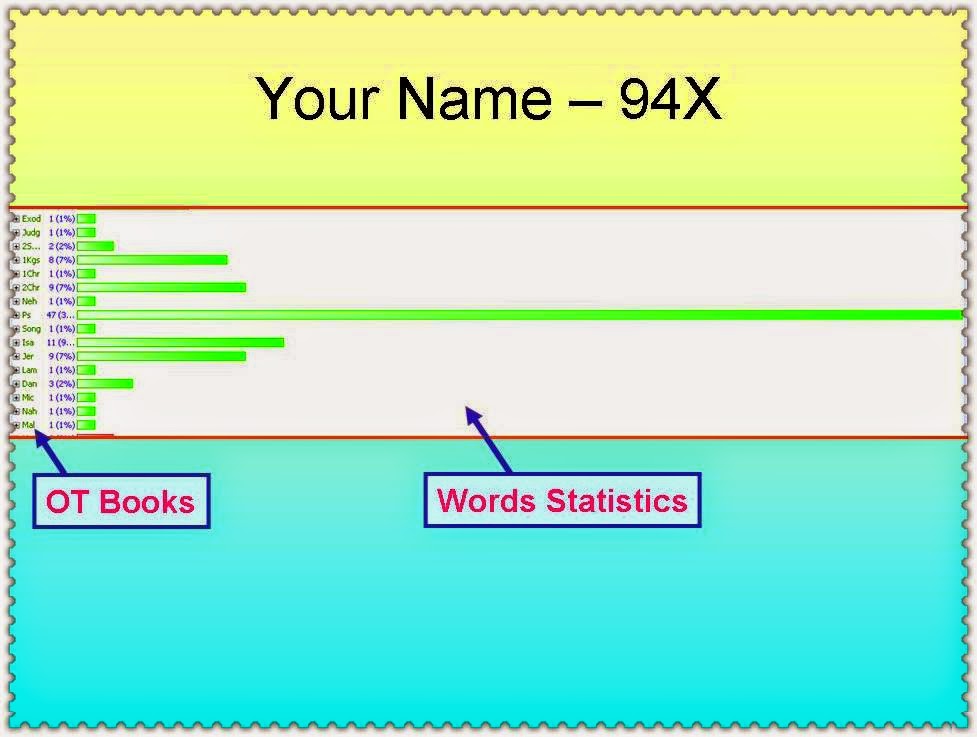
6.  Your Name - 94X


It is not surprising that "Your Name" has the most occurrence  in the book of Psalms.  While the psalmists often call on Yahweh in prayer, they are also concerned to pray to God concerning Yahweh's Name, thus "Your Name" is usually a focal point of their prayers.  

Do you ever pray to God about "Your Name . . ."?  In the Lord's prayer, Jesus instructs us to pray "Hallowed be Your Name."  


These statistics reveal to us the important emphasis God places on His Name.  When we enter into prayer, all the more, we must call on God's Name, Yahweh. This week we will call on God's Everlasting Name ever more deeply from our hearts.


:)


5/13/14

BLESSED be the Shem of Yahweh FOREVER – 23

Subject: God who is over all be "Blessed Forever" Amen.


This article is going to be a bit long. I put this into 12 sequential points for easier reading. So take your time to slowly read this one through. 

In our last article, we looked at the first occurrence where Paul uses "
Blessed Forever" in Romans. 

Today, we will look at the second occurrence – Romans 9:4-5.

"They are Israelites, and to them belong the sonship, the glory, the covenants, the giving of the law, the worship, and the promises; to them belong the patriarchs, and of their race, according to the flesh, is the Christ.
God who is over all be blessed forever. Amen."


1. This doxology in Romans 9:5 is found in the middle of Paul's lament and anguish for his kinsmen. 

He is expressing his heart's desire for his people to come to saving faith in Christ, yet they refused to do so inspite of all that God has blessed them with. As Paul lists out the privileges in Rom 9:4-5, out came his outburst of praise to God who is blessed forever for making all these promises possible.

2. The above text (Rom 9:4-5) is taken from the Revised Standard Version. 
 
   
    I chose this version because this translation is more clear and accurate. 


3. I am also including a picture of the Greek manuscript Codex Sinaiticus from AD 350 on Rom 9:5 so that you can see why there is a lot of confusion regarding the understanding of this text.


4. As you can see from the ancient manuscript, there is no punctuation marks in Romans 9:5. 
So the phrase that is in question is towards the end of Romans 9:5 – ὁ Χριστὸς τὸ κατὰ σάρκα ὁ ὢν ἐπὶ πάντων θεὸς εὐλογητὸς εἰς τοὺς αἰῶνας.

5. If you put a comma between "κατὰ σάρκα" and "ὁ ὢν", the translation will be: 

"Christ according to the flesh who is over all, God blessed forever. 
Christ and God here are in the same sentence.


6. If you put a period between "κατὰ σάρκα" and "ὁ ὢν", the translation will be: 

Christ according to the flesh. God who is over all be blessed forever.
Christ and God here are separated to two different sentences.


7. Many people are confused about Romans 9:5, because a superficial reading of using the comma version gives the impression that Christ who is God be blessed forever.


8. Paul never equates Χριστὸς (Christ) with θεὸς (God).


9. In this series of 22 articles on "Blessing God's Name Forever", we have already seen the explicit truth that "blessed be" is always used with reference to Yahweh God in OT and NT. Yahweh God is always our sole object of praise and blessed forever, not Jesus.


10. We have also seen that Paul emphasizes that it is God who is 'blessed forever' in 2 other places in his writings: Rom 1:25 and 2 Cor 11:31.


11. In Romans 9:5, Yahweh God is again the object of praise. Jesus Christ is the cause of the praise but not the object. We must not mix the two together.


12. In the context of Romans 9, Paul is expressing his anguish that his fellow kinsmen do not even realize the great privileges the Israelites have from God. They have the adoption, the glory, the covenants, the giving of the law, the service of God, the promises, the fathers and even Christ coming from among them — Wow… all these cause Paul to praise Yahweh God forevermore for the privileges given to the covenant people. It is Yahweh God who makes all this possible in Christ. 

Yahweh God, who is over all, be blessed forever. Amen!


5/12/14

BLESSED be the Shem of Yahweh FOREVER – 22

Subject: The Creator who is "Blessed Forever" Amen!


There are 2 places where Paul uses "blessed forever" in Romans. 


Today we will look at the first occurrence of "blessed forever" in Romans.

Romans 1:24- 25. "Therefore God gave them up in the lusts of their hearts to impurity, to the dishonouring of their bodies among themselves, because they exchanged the truth about God for a lie and worshiped and served the creature rather than the Creator, who is blessed forever! Amen."


1. This is a doxology. Doxo comes from the Greek word " δόξα" meaning 'glory'.

2. A doxology is a short praise glorifying God, often times ending with "Amen". We see this repeated pattern in the Old Testament where Psalmists and men of God would bless and glorify God at the end of their praises.

3. Who is "blessed forever" here in Romans 1:24-25? 

4. It is "the Creator" who is blessed forever.

5. Yahweh God is our Creator. He is the One worthy of our worship and praise, therefore we bless Him forever. Let us serve and worship our only Creator God Yahweh and not exchange the truth about God for a lie.


Yahweh God, our Creator, You are blessed forever! Amen.


5/11/14

BLESSED be the Shem of Yahweh FOREVER – 21

Subject: "God and Father of our Lord Jesus Christ"


"Blessed be the God and Father of our Lord Jesus Christ! According to his great mercy, he has caused us to be born again to a living hope through the resurrection of Jesus Christ from the dead." 1 Peter 1:3

These words are written by Peter, a disciple of Jesus. Like the apostle Paul, Peter begins his letter praising and blessing God.

1.  The phrase “God and Father of our Lord Jesus Christ” occurs 11X in the New Testament. 

2.  The New Testament apostles always make a clear distinction between God and Jesus Christ. 


What is the distinction?

1. Yahweh God is identified as the “God” of our Lord Jesus Christ.

2. Yahweh God is identified as “Father” of our Lord Jesus Christ.


The early church in the 1st Century worships God, Yahweh. 
  • He is the merciful Father who gives us the new life in Christ. 
  • He raised Jesus from the dead so that we can have a share in this living hope. 
  • Jesus Christ did not rise from the dead himself.
  • It was God who raised Him from the dead and then highly exalted him.

Blessed be the God and Father of our Lord Jesus Christ.


5/10/14

BLESSED be the Shem of Yahweh FOREVER – 20

Subject: Blessed be the "God" and Father of our "Lord" Jesus Christ


"BLESSED be the "God" and Father of our "Lord" Jesus Christ, who hath blessed us with all spiritual blessings in heavenly places in Christ. " Ephesians 1:3 

  • The focus of worship and praise is always Yahweh Father God in both the Old Testament and New Testament. 
  • Here, it is Yahweh Father who is blessed and in turn, Yahweh God blesses us with all spiritual blessings in Christ Jesus. 
  • The subject is Yahweh God.


We can take note of the following:

1. Yahweh is "God" and Father.
2. Jesus Christ is "Lord".


In the past, when I read the New Testament, I often intermixed the terms "God" and "Lord". Whenever I read, "Lord", I thought "Lord" is "God", and that "God" is "Lord".


We need to distinguish these terms "God" and "Lord". 
Do not intermix them to avoid confusion.


1.  Jesus was not born with this title "Lord". 

2.  Jesus was given the title "Lord" by Yahweh God. 

In Acts 2:36, "God has made him both "Lord" and "Christ", this Jesus whom you crucified.” 

Jesus fulfilled God's mission to be the Messiah, and that's why Yahweh God raised him up to become "Lord" (Philippians 2:9-11), to sit on His right hand in the heavenly places (Ephesians 1:20).


Paul constantly makes this distinction: 
One God, the Father and one Lord, Jesus Christ.

In 1 Cor 8:6, it says: "there is but "one God", the Father, from whom all things came and for whom we live; and there is but "one Lord", Jesus Christ, through whom all things came and through whom we live."

We worship and bless the one Yahweh God.


5/9/14

BLESSED be the Shem of Yahweh FOREVER – 19

Subject: Yahweh God is Blessed Forevermore


The God and Father of our Lord Jesus Christ,
which is blessed FOREVERMORE, knows that I am not lying. 
2 Corinthians 11:31 

These words of Paul are almost in the form of an oath, a solemn appeal to God, who can testify to the truth of what Paul is saying to the Corinthian church.


We can take note of the following 3 points:

1. God is blessed. In the OT, Yahweh God is blessed all the time. We have seen this in the last 18 articles. 

2. Yahweh God is the Father of our Lord Jesus Christ.

3. Yahweh God is blessed FOREVERMORE. Blessing 
  • Yahweh God is to continue from generations to generations. 
  • Blessing Yahweh God did not stop in the OT times. 
  • Paul continues to follow through on this important teaching in his generation. 
  • We too must learn to bless Yahweh God so that our children can learn to love God and praise the Name of Yahweh.


5/8/14

BLESSED be the Shem of Yahweh FOREVER – 18

Subject: Paul blesses God


BLESSED be the God and Father of our Lord Jesus Christ, the Father of mercies and God of all comfort. 2 Cor 1:3


Paul begins his letter to the Corinthians by blessing Yahweh God. 


Who is the focus of attention in 2 Cor 1:3? 
  • It is God, the Father of our Lord Jesus. 
  • Notice the focus of worship is not on our Lord Jesus Christ. 
  • The worship of praise is directed towards Yahweh God. 
  • Yahweh God is the Father of mercies and comfort. 

Paul is drawing on an OT image of YAHWEH as FATHER expressed in Psalm 103:13-14, “As a FATHER has compassion on his children, so יהוה YAHWEH has compassion on those who fear Him."

Let us praise Father Yahweh who comforts us & strengthens us in all our troubles as we take part in the sufferings of Christ.


5/7/14

BLESSED be the Shem of Yahweh FOREVER – 17

Subject: Zechariah blesses Yahweh God of Israel


‘Blessing the Name of God' is also a major theme in the NT.

"Blessed be the Lord God of Israel, for he has visited and redeemed his people." Luke 1:68 


These words were spoken by Zechariah when his son, John (the Baptist) was circumcised on the 8th day. As soon as Zechariah was able to speak, he praised God (Luke 1:64). He was filled with the Spirit of God and started prophesying in Luke 1:68 beginning with these words: Blessed be the Lord God of Israel …


In the NT, "Lord" can refer to Yahweh God, Jesus or to a human master. Most of the time "Lord" refers to Jesus. In Luke 1, Jesus has not yet been born, so the word “Lord” definitely refers to Yahweh God


“Blessed be Yahweh, God of Israel….” We have seen in the last 16 articles that men of God in OT constantly used this exact phrase to worship the One True God of Israel. God's Name is exalted through praise.


Zechariah is blessing Yahweh God of Israel, for God is visiting His people to redeem them through the Messiah. John the Baptist is to be the prophet of the Highest to go before the face of the “Lord” to prepare his ways (Luke 1:76). “Lord” here refers to Yahweh as this is a quotation from Isaiah 40:3, “Prepare the way of Yahweh”.


In the Greek NT, when "κύριος" Lord is used in quoting the OT, most of the time, the Hebrew has the text "יהוה" Yahweh. Therefore, we can read "Yahweh" in place of the word "Lord" in those occurrences.


Truly Yahweh God is praised and blessed.
God is truly merciful in fulfilling His promise to raise up a horn of salvation in the person of Christ with John as the forerunner.


5/6/14

BLESSED be the Shem of Yahweh FOREVER – 16

Subject: Calling on YAHWEH who is worthy of PRAISE


"I called to YAHWEH, who is worthy of PRAISE, and I am saved from my enemies." Psalm 18:3

Last time, we saw that Job was under spiritual attack, and in his pain and sorrows, he called on Yahweh and blessed the Name of Yahweh. God is worthy of our praise on the basis of WHO He is, apart from blessings He bestows on us. This is the secret of Job's life in face of all his loss.

Psalm 18 is psalm of David.
He too, like Job, recognizes that Yahweh God is worthy of praise. He called on the Name of Yahweh and praised Him to overcome spiritual battles. Yahweh God delivered him from the hand of all his enemies and from the hand of Saul.


David is praising God in the middle of spiritual battles. Here is an important connection of calling on the Name of God and praising Yahweh's Name, especially under severe spiritual attacks. God responds. The enemy flees. God's Name is honored.

We are familiar with praising God when the music is on, when the drum is beating, when the pianist dances beautiful music on the piano, or when the singspiration leader leads us with singing. We seem to think that church worship is the best environment that is suitable to bless and praise God. Not so. Learn true spiritual meaning of praising God at all times, especially under the pressure of severe spiritual attacks,  because He is worthy of praise all the time.


5/4/14

BLESSED be the Shem of Yahweh FOREVER – 14


Subject: Levites Bless Yahweh's Glorious Name FOREVER


Stand up and bless Yahweh your God forever and ever. "Blessed be thy glorious Name, which is exalted above all blessing and praise." Nehemiah 9:5


Nehemiah was a great servant of God who feared God's Name
(Neh 1:11). After 70 years of Babylonian captivity, Nehemiah returned to Jerusalem and remained there for 12 years to help build up God's people.

Nehemiah 9 is probably one of the longest recorded prayer in the Bible. Here, the Levites led the Israelites in prayer. Right at the beginning of their prayers, they blessed the glorious Name of Yahweh. When the Levites gathered the people to prayer, the first thing they said to the people was: "Stand up and praise YAHWEH God, FOREVER and EVER." 

This event tells us something very SIGNIFICANT:
Even after 70 years in Babylonian captivity, the Name of God, Yahweh was never forgotten. Please take note that the Levites led the congregation to praise YAHWEH and bless the glorious Name of God. They knew God as YAHWEH and called on YAHWEH. 

Secondly, the Levites also instilled on the hearts of the Israelites that God's Name, Yahweh, must be praised and blessed FOREVER and EVER. They remembered the teaching of Moses back in Exodus where God says: "This Is My Name FOREVER." So now, after 70 long years away from Jerusalem, the new generation of Levites reminded the people again that Yahweh's Name be blessed FOREVER and EVER. The Israelites needed to teach their children to bless and praise Yahweh God from generation to generation.


Isn't this interesting? In the past, we were given the impression that the Israelites did not use God's Name, Yahweh anymore after the exile. This is simply not true. Actually in the books of Ezra and Nehemiah, the Levites continued to teach God's people to call on Yahweh Name as this is God's Name FOREVER and EVER.